|
Analog PLLs & DLLs
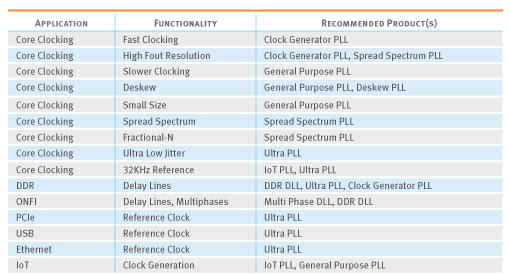
True Circuits offers six general categories of low-jitter PLL hard macros:
Ultra PLLs, IoT PLLs, General Purpose PLLs, Clock Generator PLLs, Spread Spectrum
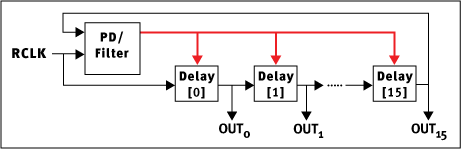
PLLs, and Deskew PLLs. We also offer low-jitter Multi-slave DDR DLL and
Multi-phase DLL hard macros. These hard macros have excellent jitter
performance while operating in the hostile mixed-signal noise environment
present in today's ICs. They span nearly all performance points and features
typically requested by ASIC, FPGA and SoC designers. Our PLLs support wide
frequency and multiplication factor ranges, ultra low jitter and are fully
pin programmable. Our DLLs have excellent linearity, very high resolution
and are ideal for high-speed DDR and other interface applications. These PLL
and DLL hard macros are available in TSMC, GLOBALFOUNDRIES and UMC logic
processes from 180nm to 4nm.
True Circuits offers a PLL specifically
tailored to the stringent power requirements and wide frequency operation
range of the rapidly growing IoT market. Sipping only 45uW at 30MHz and
running from core power, the IoT PLL is designed for very low power. With
multiplication factors up to 8192, the PLL is able to run off of a small and
inexpensive 32KHz crystal and still clock a 32-bit CPU at up to 250MHz. The
IoT PLL is ideal for applications like wearables and sensor devices, where
the power-performance profile must be managed tightly, and possibly over a
very wide frequency range.
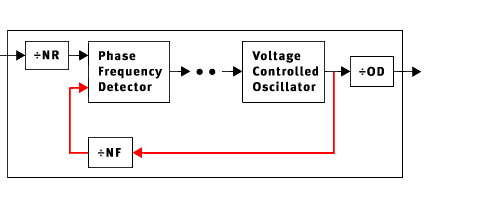
True Circuits offers a state-of-the-art LC PLL that uses high-speed digital
and analog circuits to achieve exceptional performance, with many useful
features. The Ultra+ PLL is highly programmable so one PLL can be used for
all applications on a SoC. It has an innovative digital control algorithm that
cuts the lock time by as much as 70% over previous versions, while directly
controlling the loop bandwidth accurately (0.1% of Fref or better) and
consistently across PVT variations through continuous background loop-gain
calibration. It has ultra-low jitter performance (<100fs) for the most demanding
SerDes and ADC reference clocks and ultra-wide multiplication range (1-250,000)
to support reference clocks from 32KHz to 1GHz.
The Ultra+ PLL offers precise frequency control with a least 26 fractional
bits (at least 10 precise) for extremely high fractional-N resolution. It can
also generate precise and adjustable frequency spreading with programmable rate
and depth to meet tight FCC requirements. The Ultra+ PLL does all this while
drawing low power from a compact size. The PLL can be delivered as synthesizable
or hardened IP with a modular design, so customers can build their own features
easily and safely using hard macros and stock Verilog code.
Digital PLLs & DLLs
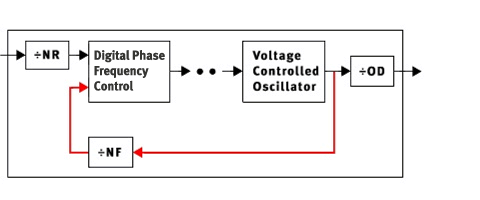
True Circuits has introduced new synthesizable PLLs and DLLs that will continue to raise the bar for timing IP features, performance and flexibility for a wide range of customer applications. Since 1998, TCI has led the industry with the regular introduction of new timing architectures and IP design types that have defined the timing IP category, and offered chip designers a wide variety of solutions to their timing needs. TCI is proud to offer our latest timing IP, the synthesizable Precision PLL, micro PLL and micro DLL. Each is available in the latest process nodes and back to 28nm.
The synthesizable Precision PLL generates multiple precision clocks supporting any modulation scheme from almost DC to 10GHz. The outputs can be independently dynamically programmed cycle-by-cycle to any clock period and the clock frequency can be a precise ratio of floating point numbers times the reference frequency. The integrated phase noise is better than 500ps RMS. It is ideal for SerDes, processor and DVFS applications.
The synthesizable micro PLL is a small synthesizable general-purpose PLL that multiplies the reference clock by any integer or fractional-N value from 1 to 500K. It supports reference clock frequencies as low as 32KHz and output frequencies as high as 3GHz. It can stay locked to the reference clock while it changes over a 10:1 frequency range. Because it is synthesizable, it can support spreading as well as other modulation profiles. It is relatively low power, very fast locking and can quickly restart from a sleep mode.
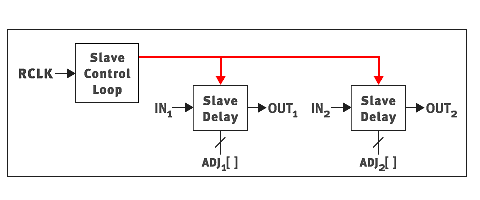
The synthesizable micro DLL is a small synthesizable DLL with a master and multiple slaves topology. It can support reference frequencies typically in the range of 500MHz to 3GHz and track reference changes over an 8:1 frequency range while providing 9-bit accuracy in slave delay programming. Slave delays can be changed glitch free and the DLL can quickly restart from a sleep mode. It has a very small zero code offset that can be precisely cancelled.
True Circuits' continuous product improvements and product additions are driven by lab experience, customer requirements and our unique understanding of real world timing applications.
|